Welcome to Extension History. This blog has been set up for you to access the various readings, sources and activities associated with the case study we will be looking at this year, The Early History of Israel.
The first thing each of you needs to do is set up your own blog. Simply go to Blogger and follow the instructions.
Your blogs will be added to the blogroll at the side of this page. For each of the activities posted on this page you are expected to create a blog post, and post a link to your response in the comments section of the relevant activity.
As a recap, here is the PowerPoint we viewed in class today:
Wednesday, October 26, 2011

Origins & naming of the Hebrews
This activity involves looking at two epigraphical sources that possibly make reference to the people of Israel.
You are to create one blog post discussing each of the sources presented below. As well as discussing the content and what this means for the origins and naming of the Hebrews, you need to consider and discuss:
The Merneptah Stele
There are 133 lines on this stele, but those relevant to us are:
The Great Ones are prostrate, saying "Peace";
Not one raises his head among the Nine Bows;
Plundered is Thehenu, Khatti is at Peace;
Canaan is plundered with every evil;
Ashkelon is conquered;
Gezer is seized;
Yano'am is made non-existent;
Israel is laid waste, his seed is no more;
Kharu has become a widow because of Egypt;
All lands together are at peace;
Any who roamed have been subdued.
Readings:
Finkelstein & Silberman, The Bible Unearthed, p.57, 60, 101-103
Miller & Hayes, A History of Ancient Israel & Judah, p.39-42
What do you make of this article by Joseph Davidovits?
Tell el-Amarna letters
Read the letter here. You are looking at the use of the word 'Apiru.
Refer to the Lacey excerpt 'Naming of the 'Hebrews'' from The Origins and Early History of Israel: An Introductory Note, discussing Habiru.
Read Miller & Hayes, A History of Ancient Israel & Judah, p.32-33.
*TEP note*
- activity based on sources
- area of debate: Origins and naming of Hebrews
You are to create one blog post discussing each of the sources presented below. As well as discussing the content and what this means for the origins and naming of the Hebrews, you need to consider and discuss:
- where the source was found
- where the source originated
- the author (and all the issues that come with this question - bias, purpose, etc)
- the state the source is in - is there too much missing to draw conclusions?
Remember to post a link to your blog entries in the comments below. One blog entry of at least 250 words is required for each source.
The Merneptah Stele
There are 133 lines on this stele, but those relevant to us are:
 |
| Image: Wikipedia |
Not one raises his head among the Nine Bows;
Plundered is Thehenu, Khatti is at Peace;
Canaan is plundered with every evil;
Ashkelon is conquered;
Gezer is seized;
Yano'am is made non-existent;
Israel is laid waste, his seed is no more;
Kharu has become a widow because of Egypt;
All lands together are at peace;
Any who roamed have been subdued.
Readings:
Finkelstein & Silberman, The Bible Unearthed, p.57, 60, 101-103
Miller & Hayes, A History of Ancient Israel & Judah, p.39-42
What do you make of this article by Joseph Davidovits?
Tell el-Amarna letters
 |
| Image: Associates for Biblical Research |
Read the letter here. You are looking at the use of the word 'Apiru.
Refer to the Lacey excerpt 'Naming of the 'Hebrews'' from The Origins and Early History of Israel: An Introductory Note, discussing Habiru.
Read Miller & Hayes, A History of Ancient Israel & Judah, p.32-33.
*TEP note*
- activity based on sources
- area of debate: Origins and naming of Hebrews
Conquest or Settlement?
This learning activity will investigate whether Israel came about due to conquest or settlement. There are two parts to this activity.
The first part of this activity requires research.
Consider the different 'schools' of thought regarding this issue put forward by Fritz. Write a blog post outlining each of these schools of thought, and the arguments put forward for and against.
Make sure you refer to the specific archaeological, epigraphical and Biblical evidence Fritz has presented in his article.
Readings:
Fritz, V., 'Conquest or Settlement?' in Biblical Archaeologist 50 (1987) pp.84-100 (received in class)
Obituary of Volkmar Fritz
Post a link to your blog post in the comments below.
For the second part of this task you will be put into pairs.
Each pair will be allocated one of the schools of thought put forward by Fritz and will need to put together a presentation using either PowerPoint or Prezi. You will use the blog entries from the rest of your classmates as the basis for the content of your presentation.
The presentation needs to cover:
Your presentation also needs to be embedded into your blog using either SlideShare or directly embedding via Prezi. The presentation should be between 6 and 8 minutes.
*TEP Assignment notes*
- at least one requiring informed student discussion
- area of debate: Conquest or Settlement
The first part of this activity requires research.
Consider the different 'schools' of thought regarding this issue put forward by Fritz. Write a blog post outlining each of these schools of thought, and the arguments put forward for and against.
Make sure you refer to the specific archaeological, epigraphical and Biblical evidence Fritz has presented in his article.
Readings:
Fritz, V., 'Conquest or Settlement?' in Biblical Archaeologist 50 (1987) pp.84-100 (received in class)
Obituary of Volkmar Fritz
Post a link to your blog post in the comments below.
For the second part of this task you will be put into pairs.
Each pair will be allocated one of the schools of thought put forward by Fritz and will need to put together a presentation using either PowerPoint or Prezi. You will use the blog entries from the rest of your classmates as the basis for the content of your presentation.
The presentation needs to cover:
- An overview of the theory
- Which historians support this view
- What archaeological and epigraphical evidence supports this view
- What Biblical evidence supports this view
- How the theory and support for it has changed over time
- Your pair's evaluation of this theory
Your presentation also needs to be embedded into your blog using either SlideShare or directly embedding via Prezi. The presentation should be between 6 and 8 minutes.
*TEP Assignment notes*
- at least one requiring informed student discussion
- area of debate: Conquest or Settlement
Emergence of the monarchy & kingdom of Israel
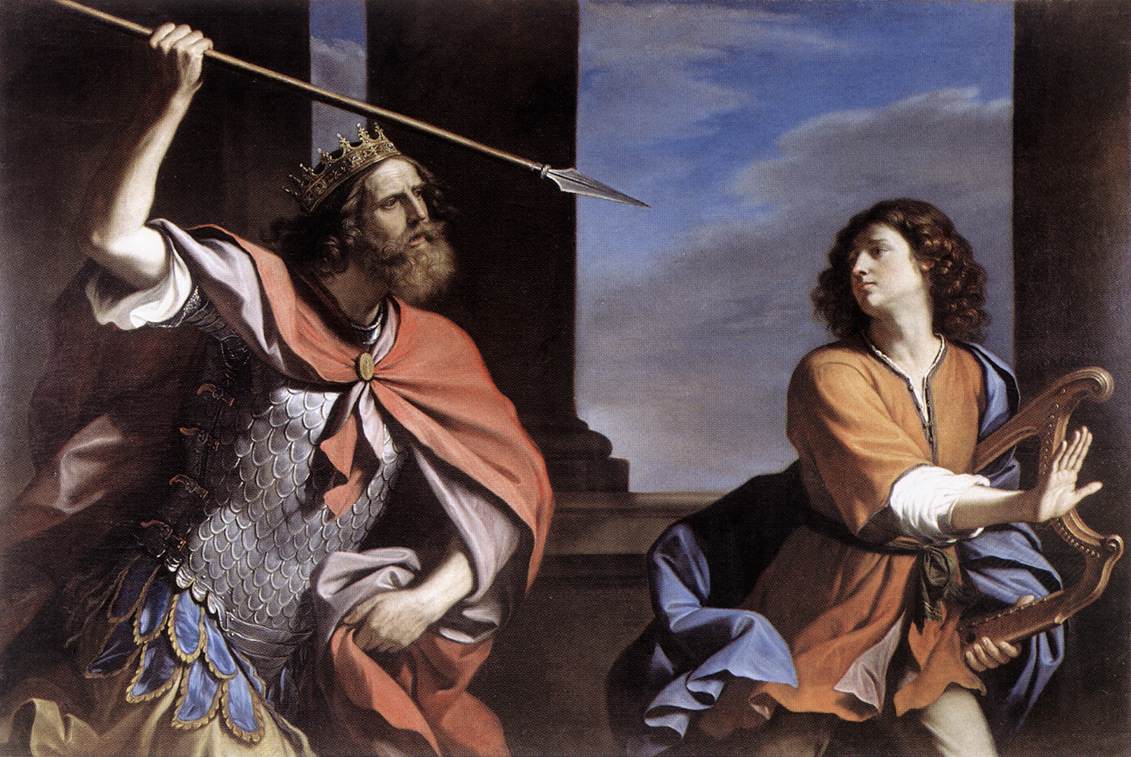 |
| Image: The Web Gallery of Art |
As we discussed in class, Saul is considered the first of the actual monarchs of Israel. The image above is a 1646 painting by Guercino and is currently in the Galleria Nazionale d'Arte Antica in Rome.
This activity requires you do do multiple things
- Summarise the two distinct narratives regarding Saul in 1 Samuel 1 - 14.
- Include information such as what can we identify as being a monarch's duty?
- Discuss any overlaps and contradictions such as what reasons are given for Saul's appointment as monarch.
- What does this tell you about the authorship of 1 Samuel?
- Consider the Guercino painting.
- What sort of representation is presented here?
- How does Guercino's context influence the way he represents Saul?
- Read Finkelsten & Silberman The Bible Unearthed p.124-127 and the chapter 'The Madness of Saul' in their other book David and Solomon p.61-89. In your blog entry discuss
- What do these modern historians have to say about the Biblical evidence?
- What does the title of the chapter tell you about the author's attitude towards Saul?
- Now read Miller and Hayes A History of Ancient Israel and Judah, p.129-145.
- Is there anything you can add about modern scholarship on this issue of Saul?
*TEP Assignment notes*
- requiring a written response related to a historiographical issue
- area of debate: emergence of the monarchy and kingdom of Israel
Subscribe to:
Posts (Atom)